Types of Generative AI
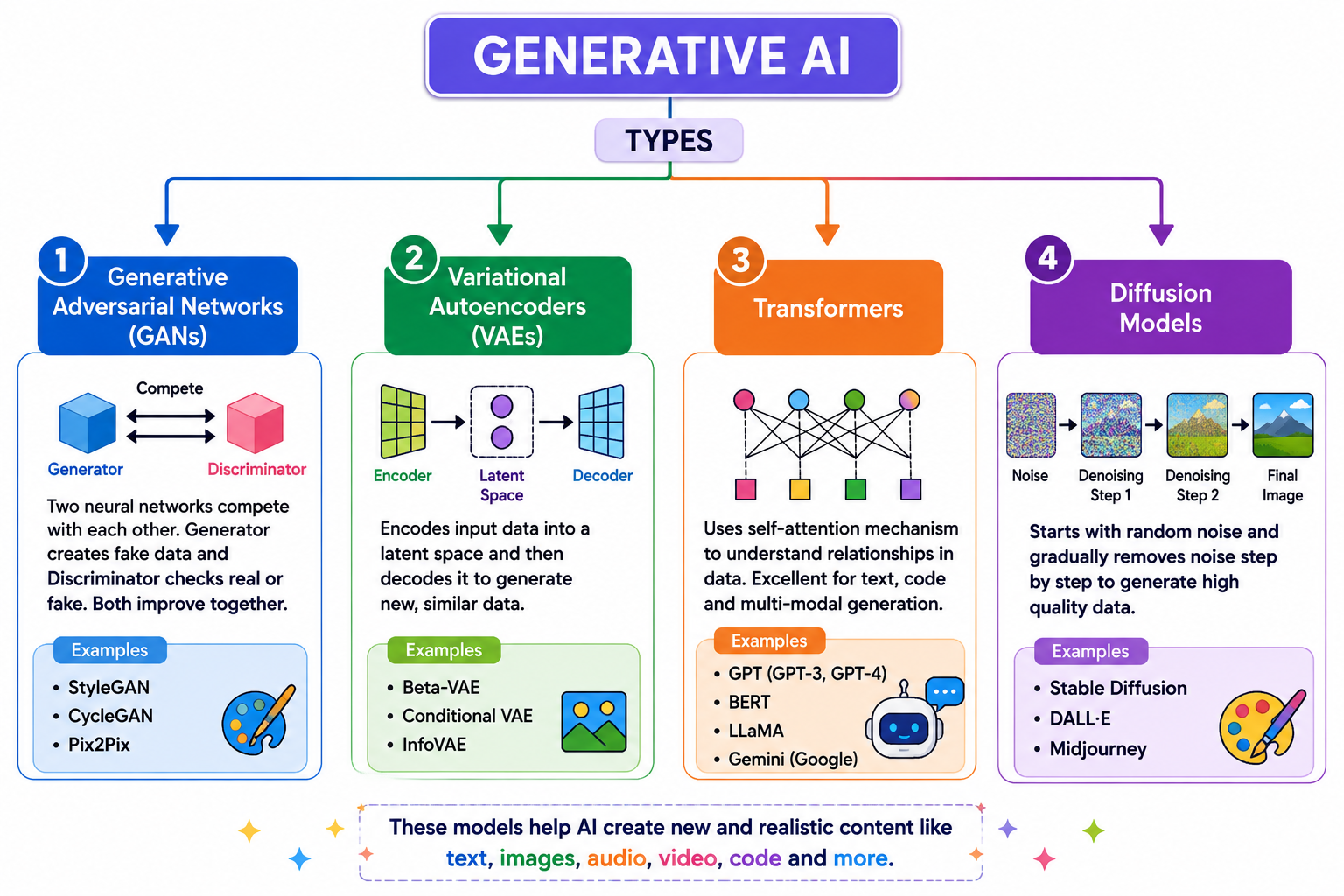
- Generativw Adversarial Networds (GANs): A GAN is an AI model where two neural networks compete with each other to create realistic new data.
Generator: Creates fake data.
Discriminator: Checks whether the data is real or fake.
The Generator keeps improving until it can fool the Discriminator.
Example- Creating realistic human faces, AI-generated artwork, etc.
Another Example- Imagine a student and a teacher:
The student draws a fake ₹500 note.
The teacher checks whether it is real or fake.
If the teacher finds mistakes, the student improves the drawing.
After many attempts, the fake note looks almost real. - Variational Auto Encoders (VAEs): A VAE is an AI model that learns the important features of data and then creates new, similar data. It works in two steps:
Encoder: Learns the important information.
Decoder: Uses that information to generate a new example.
Real-life Examples- Creating new handwritten digits, Generating new faces, etc.
Another Example- Imagine you want to draw a flower.
First, you learn the common features like petals, stem, and leaves.
Then, you draw a new flower that looks different but still resembles a real flower. - Transformers: A Transformer is an AI model that understands the meaning and relationships between words or other data, allowing it to generate accurate and meaningful content.
Real-life Examples - ChatGPT, Google Translate, AI coding assistants, Text summarization, etc.
Another example - When you read the sentence:
"Riya dropped the glass because it was slippery."
You understand that "it" refers to the glass, not Riya.
A Transformer learns this relationship and uses it to generate meaningful text. - Diffusion Models: A Diffusion Model is an AI model that starts with random noise and slowly removes the noise until a clear image is created.
Real-life examples- AI image generation, Photo editing, AI art creation, etc.
Another Example - Imagine a TV showing only static noise. As you adjust the signal, the picture gradually becomes clear.
A Diffusion Model works in the same way:
Starts with random dots (noise), Removes the noise step by step, and Produces a realistic image.